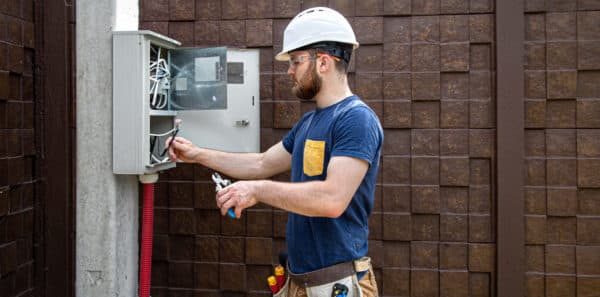
Most Coachella Valley homes constructed after 1965, as well as those built before that date that have updated electrical services, use circuit breakers to protect the electrical circuits in the home. However, many houses constructed before 1965 use fuses housed in the main fuse box.
A circuit breaker and a fuse protect your circuits from overloads and short circuits. You can reset a circuit breaker, but you must replace a fuse when it burns or blows out.
There are several reasons why a fuse can blow. Before discussing these reasons, you need to understand a little bit about a fuse and how it operates.
The Makeup of a Fuse
Fuses can control 120V circuits or 240V circuits. A 120V circuit fuse is small, ceramic, and screws into a threaded socket inside the fuse panel. It’s like screwing a light bulb into a lamp socket.
When you look inside the fuse, you will see a thin metal ribbon. This is where all the current passes. The size of the ribbon matches the circuit wire gauge. If an excessive amount of current passes through the ribbon, the ribbon will melt or blow, breaking the circuit and causing it to go dead.
On the face of the fuse, there is a window that lets you see the metal ribbon. When the fuse blows, you can see that the ribbon is broken or the glass is cloudy. Most screw-in fuses are either 15, 20, or 30 amps.
The 240V circuit is used for larger appliances, like your electric stove and air conditioner, and looks like a small cartridge. It sits between metal contacts and is pressure fitted into the fuse box. If it blows, it’s easy to pull it out and replace it with another fuse. The 240V fuse cartridges are for appliances that draw 30, 40, or 50 amps.
The Sizing of Fuses
Fuse sizes are based on the gauge of the circuit wires in the home. This way, the circuit wires cannot draw more power than they can handle. The correct fuse size is essential to prevent damage or fires from circuit overload.
Fuses with an Edison base prevent the wrong-size fuse from being inserted into the socket. If the fuse panel in your home does not have an Edison base, talk to our team of electricians at Home Team Electric. We would be happy to discuss installing them with you or examine the possibility of updating your system to use a circuit breaker.
Conditions That Cause a Fuse to Blow
The most common cause of a blown fuse is too many appliances drawing power from a circuit. The circuit overloads, and the metal ribbon inside the fuse melts.
Anything connected to that circuit, be it outlets, lights, or appliances, will stop working. You can look at the fuse and see if the metal ribbon has melted or if the glass window is foggy or cloudy. The immediate solution is to replace the fuse. However, if you do not reduce the load on the circuit, you’re just going to blow a fuse again.
Appliances that generate heat, like an iron or a toaster, and those that have motors, like a vacuum cleaner, can cause overloads. They pull a lot of power, especially when you turn them on. The following things could happen inside your home or the electrical system and cause you to blow a fuse frequently.
Short Circuit
A short circuit is an electrical fault when an electrical current goes beyond its intended path or circuit. This occurs when there is low resistance from a circuit breaker, fuse, or insulation.
The result is that the conductors that supply electrical power to the circuit have a weak connection. This leads to too much current flowing in the power source via the fault or short.
When wires are overloaded, they overflow with electricity and cause damage. A short circuit could potentially destroy the electrical device connected to the outlet. Fuses stop short circuits by blowing when there is an electrical overload.
Ground Fault
To understand a ground fault and why it can lead to a blown fuse, it’s good to know how an electrical circuit works. In the electrical circuit, there is a neutral and a hot wire that, when connected, allows electricity to flow through the device from its source to load and back again, creating a continuous cycle. A third wire, a ground wire, connects the device to the earth via a grounding rod.
A ground fault happens when electricity strays from its planned path to the ground. Since the path to the environment is unrestricted and there is no resistance, the flow of the charge drastically increases.
Ground faults are hazardous in bathrooms, garages, kitchens, and other areas with a lot of moisture. Electricity, looking to reach the ground, could travel to the outside of an appliance. Then, when someone unknowingly touches it while in a moist environment, their body becomes a conduit for electricity to go to the ground.
While an electrical shock is the most common danger of a ground fault, fires and burns can also happen. When there is a sudden surge in electricity, as is seen in a ground fault, a fuse will blow, cutting off the electricity and protecting people and property from damage.
Damaged or Outdated Electrical Outlets and Wiring
If you have faulty wiring or connected parts, your system is at risk of a power surge that will blow a fuse to protect your home, devices, and people. A damaged electrical outlet may show signs of burning, or parts of the outlet may have melted from the electrical surge. If your fuse blows because of a problem with your electrical outlet, the fuse is working exactly as it should.
The same principle applies to damaged wiring. The difference is that damaged wiring can go unnoticed for a long time because it is hidden inside walls. If you are dealing with constantly blown fuses and think that damaged wiring could be the issue, keep track of how frequently your fuses are blowing and which fuses do so. Look for flickering, buzzing, or dimming lights. If you see discoloration along the walls, feel heat or vibration generating from wall outlets, or smell burning or odd odors, it’s possible that your wiring is the culprit.
Damaged or frayed wiring is hazardous. In addition to blowing your fuses, it could start a fire inside your walls without notice, putting you and your family at risk.
At Home Team Electric, we strongly recommend contacting our experienced electricians today if you see any signs of frayed or damaged wiring or if you are experiencing frequently blown fuses and don’t know why. Let us help you identify the reason for your electrical issues and take steps to keep you and your family safe.
Quality Electrical Services Throughout the Coachella Valley
With Home Team Electric, you can trust the type of service you’re going to receive from our experienced and licensed electricians. We offer 100% satisfaction guaranteed on our electrical services, and we have built a reputation for going the extra mile and sticking to our word.
Our services include panel inspections and replacements, whole-home rewiring, electrical upgrades, and outlet repair, installation, and maintenance. We work with EV charging stations and install grounding systems and GFCI (shock prevention) and AFCI (fire prevention) protection. Contact Home Team Electric in the Coachella Valley to learn what sets our team apart from the rest.
Google Search
Get more of our updates on Google
If our work has been helpful, add us as a preferred source: Google will show more of our updates in your Top Stories and AI results. It only changes what you see.
Add as Preferred SourceWritten By

Frank Luersen
leadership
There's a running tradition inside Home Team Electric called Frank Pranks, and it says everything about the kind of culture Frank built. Ask anyone on the team about it and they'll grin before they finish explaining it. Someone sets it up, he walks right into it, the room erupts, and whether he actually sees it coming is still an ongoing debate. Frank could settle it anytime. He hasn't.
California C-10 Electrical Contractor License #879507. Verify it at cslb.ca.gov.
Published November 18, 2022