Residential Electrical
16,000+ homeowners served.

Whole Home Surge Protection

Home Team Electric has installed and serviced whole home surge protection across the Coachella Valley and Morongo Basin since 2006, with over 25,000 completed residential projects.

Licensed, Bonded & Insured · C-10 #879507
Emergency Service, Day or Night
Serving the Desert Since 2006

The Short Answer

What does a whole home surge protector actually do for my home?

Whole Home Surge Protection
Emergency electrical service badge
BBB Accredited Business

A whole home surge protector is installed at the main electrical panel and protects every circuit, every appliance, and every electronic system in the home from voltage spikes. Most surges aren't dramatic. They're small, daily events that gradually degrade the electronics inside refrigerators, AC systems, smoke detectors, and every other device running on the system.

  • Protects all circuits from the moment power enters the home
  • Prevents cumulative degradation of appliances and safety devices
  • Required by NEC 2020 for new installations due to fire prevention evidence
  • Catches internal surges from AC compressors and pool pumps at the source
  • Desert climate multiplies surge stress through grid strain and monsoon lightning
  • Claims assistance included with Home Team Electric systems at no extra charge
California Licensed, Bonded & Insured · C-10 #879507
Weekly Classroom Training in Our Own Training Room
Same-Day Service Available

Last verified: August 2026

28
Founder's Years in the Trade
25,000+
Residential Projects
4.9
from 1,608 Google Reviews
$99
Business-Hours Service Call

Book a Service Call

Lost electronics to a surge? Let's stop the next one

An electrician evaluates your panel and grounding, then explains exactly what a Type 2 device would protect and why. Same-day.

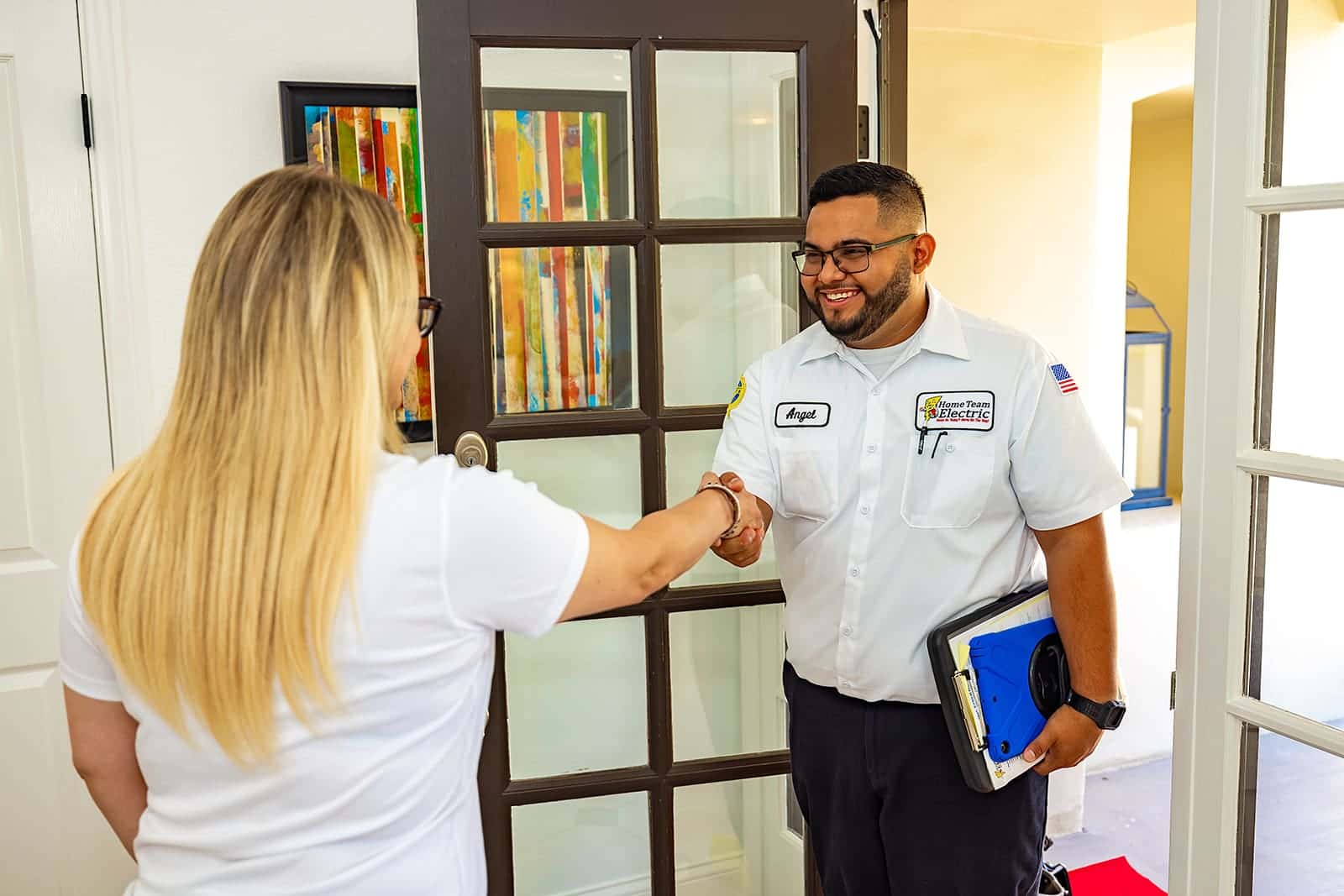
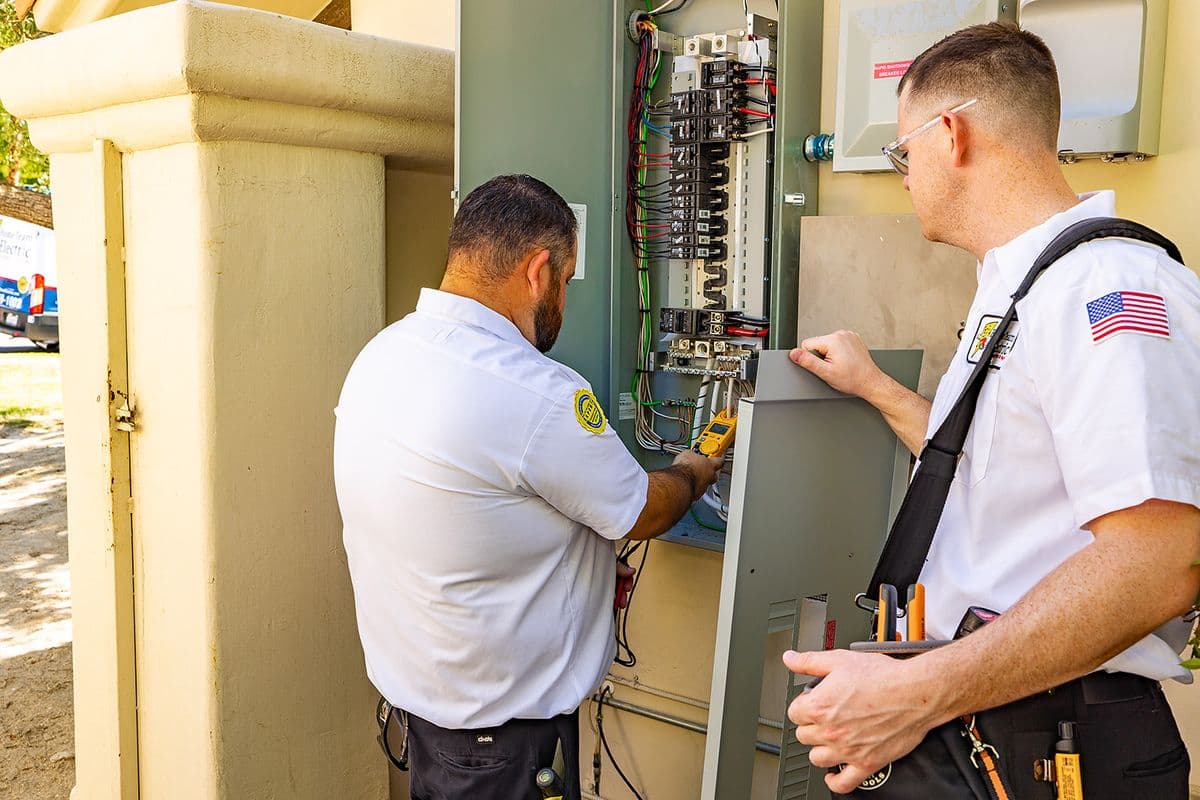
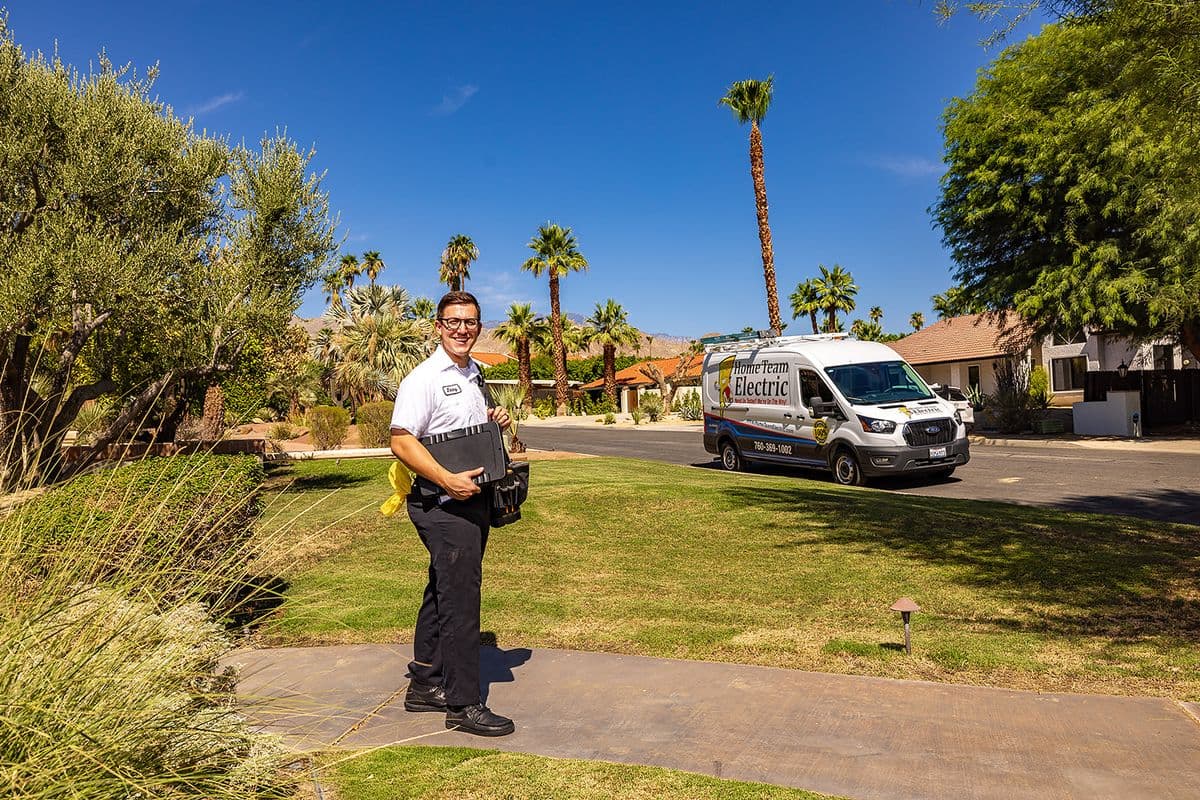
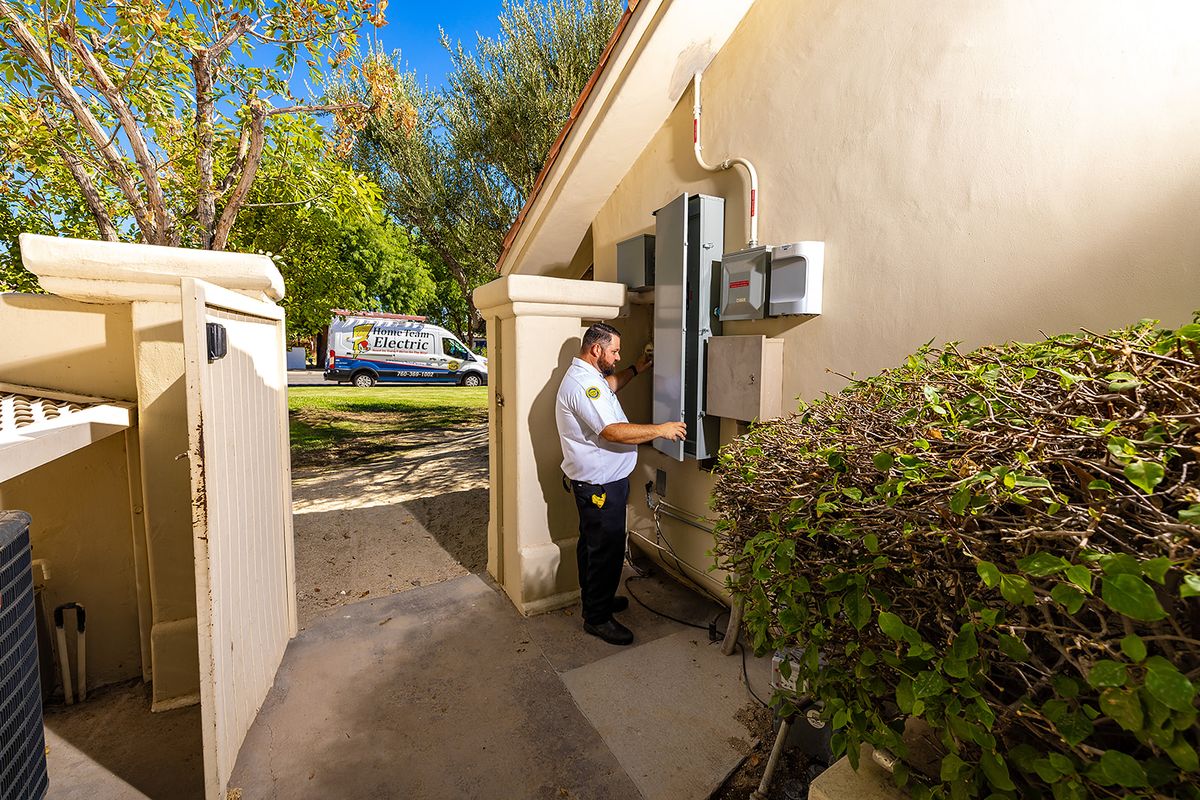
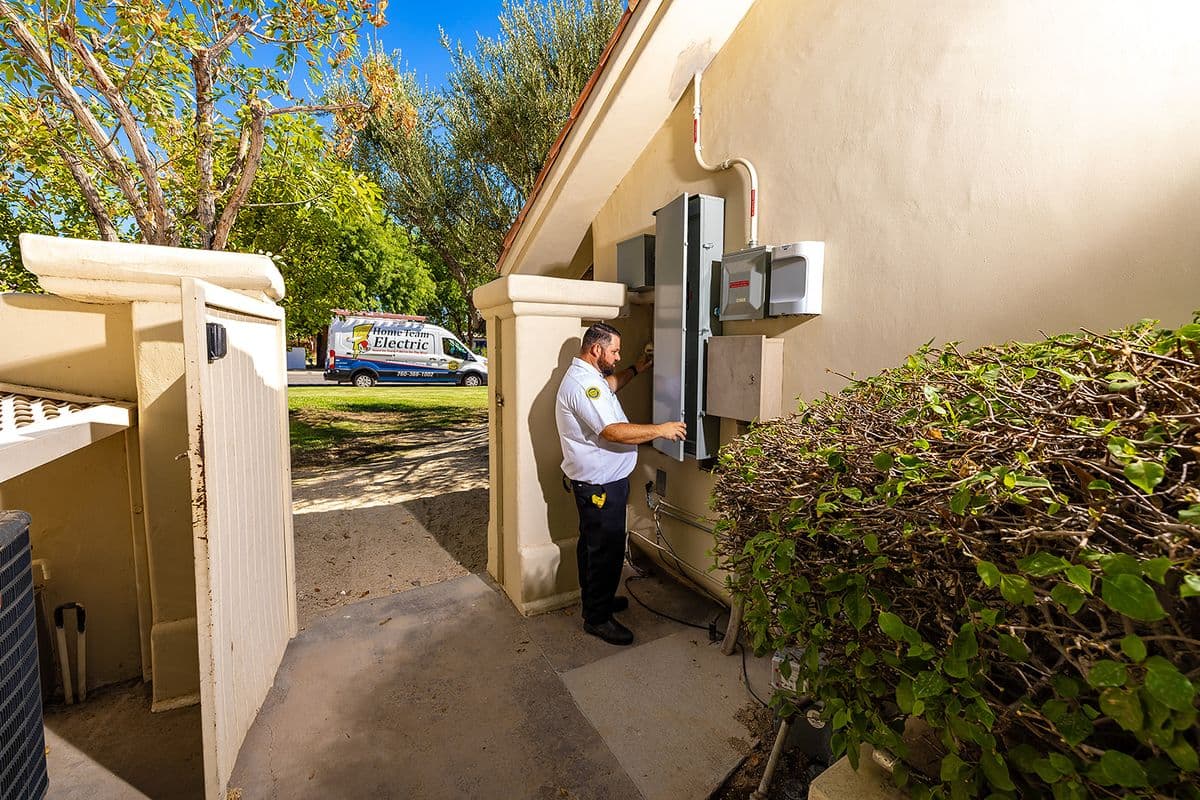
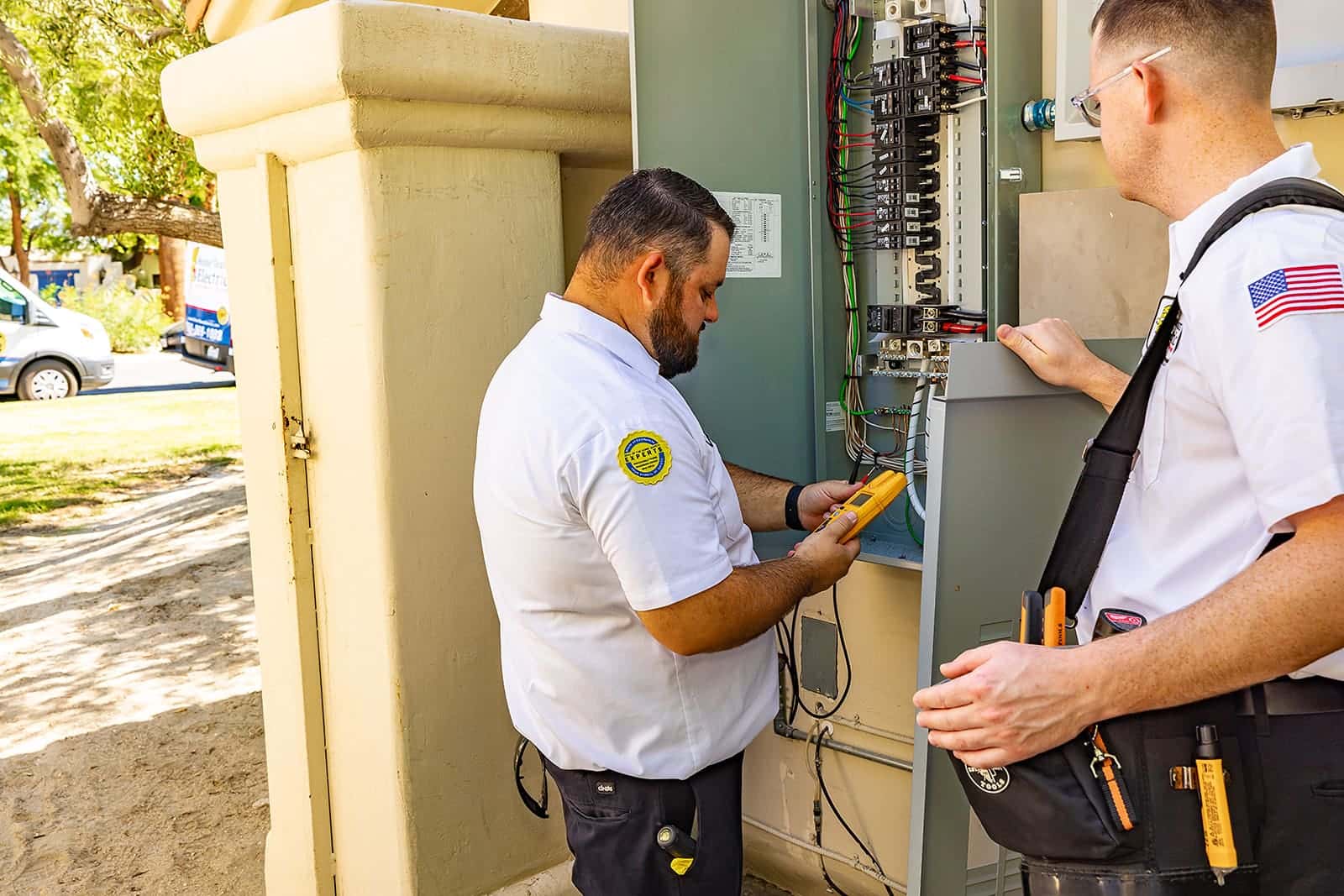
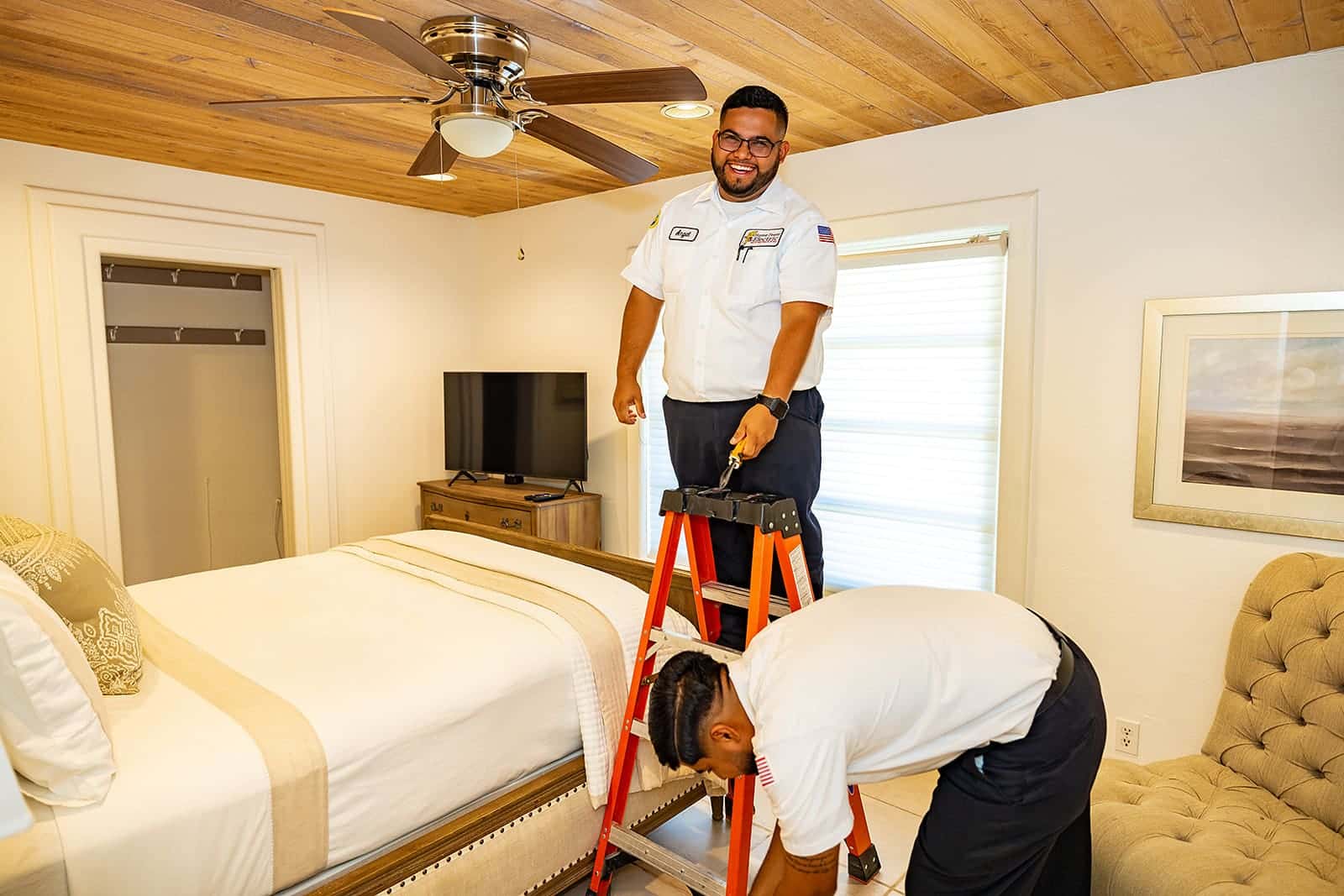
An electrician from Home Team Electric on a residential job in the Coachella Valley and Morongo Basin

Know the Signs

Signs Your Home Needs Surge Protection

Most homes have no surge protection at the panel at all, and the damage shows up slowly before it shows up all at once. If any of these sound familiar, it's worth having an electrician look at your panel and grounding.

  • 01

    Electronics that fail before their time

    A TV that dies in three years, a microwave board that quits, a router you replace more often than seems right. Big lightning strikes get the blame, but most surge damage is the small stuff. Dozens of minor voltage spikes a day, from the grid and from inside your own home, that wear electronics down quietly. Think of it like rust instead of a crash. One event rarely kills the device; the accumulation does. When gear keeps dying early with no clear reason, unprotected surges are a common cause.

  • 02

    Power strips doing the panel's job

    A plug-in surge strip protects whatever is plugged into that one outlet, and nothing else. Your AC, your furnace blower, the EV charger, the pool pump, the hardwired appliances, none of those sit behind a strip. Those are the expensive things a surge can reach, and they're exactly the ones a power strip can't help. If your whole surge strategy is a handful of strips behind the entertainment center, the rest of the home is wide open.

  • 03

    Lights that flicker or brighten when equipment cycles

    When the AC compressor kicks on or a well pump cycles, a brief voltage swing travels through the home. A small flicker can be normal. Lights that surge brighter, bulbs that burn out fast, or dimming that ripples across rooms can signal voltage instability the panel isn't smoothing out. Those same swings stress every sensitive board in the house. A panel-level device clamps the spikes before they spread to the circuits.

  • 04

    You're adding an EV charger, solar, or a heat pump

    Modern electrification packs more sensitive electronics into the home than ever. An EV charger has a control board worth protecting. Solar inverters, smart panels, variable-speed pool pumps, and heat-pump HVAC all run on circuitry a surge can fry. As you add these high-value systems, the cost of an unprotected surge climbs with them. This is the moment most homeowners realize the panel itself was never protected, and it should be before the new equipment goes in.

  • 05

    Desert utility power and summer storms

    The grid out here takes a beating. Heat-driven demand, utility switching, and the monsoon season's lightning all push surges down the service line into your home. A nearby strike doesn't have to hit the house to send a spike through the wiring. Repeated grid events are the most common surge source, and a Type 2 device at the panel is built to take those hits over and over so your electronics don't. In the Coachella Valley and Morongo Basin, that exposure is a year-round reality.

  • 06

    An older panel with no surge device installed

    Whole-home surge protection wasn't standard in older construction, and many panels still have nothing on the bus. The newer code expectation is a surge protective device at the service, but an existing home doesn't get one retroactively unless someone installs it. If you've never had a surge device added, you almost certainly don't have one. Pulling the panel cover is the only way to know for sure, and that's part of what an evaluation checks.

  • 07

    A grounding system you've never had checked

    Surge protection only works if the home is grounded properly, because a surge device needs somewhere safe to send the excess energy. An old, corroded, or undersized ground means even a good device can't do its job. Loose neutrals and weak grounds are common in homes that have never been inspected. Before adding surge protection, an electrician confirms the grounding is sound, since the two work together or not at all.

Frank's Translation

What Surge Protection Actually Does

Power from the utility isn't perfectly steady. Voltage rises and falls all day, and now and then it spikes hard, from a grid event, a lightning strike, or even a large motor cycling inside your own home. A whole-home surge device sits at the main panel and watches that incoming voltage.

Think of it like a pressure-relief valve on a water line. When the pressure spikes, it dumps the excess safely before it bursts a pipe.

When voltage climbs past a safe level, a Type 2 device clamps it in an instant and diverts the excess energy to ground, before it reaches your AC, your electronics, or your appliances. The wiring downstream only ever sees power inside the safe range.

It doesn't generate or store power, and it isn't a battery backup. It's a gatekeeper. It catches the spikes coming in from the street and the ones born inside the house, so the surge stops at the panel instead of traveling out to everything plugged in.


An electrician from Home Team Electric on a residential job in the Coachella Valley and Morongo Basin

Dead routers, fried boards, appliances that quit early. Those aren't bad luck. They're the surges you never saw.

The Three Layers

Where Should Surge Protection Live?

Surge protection isn't one product. It's a layered defense, and most homes are missing the layer that matters most. The plug-in strips behind the TV only guard one outlet each. The big loads, the AC, the furnace, the EV charger, the hardwired appliances, sit completely exposed because nothing protects them at the source. Real protection starts at the panel and works outward, so the largest and most expensive surges are caught before they ever reach a circuit. Industry classes surge devices into three standard types by where they install.

Here's how the three standard types compare, and where each one belongs in a real home.

Before the meter

Type 1

SERVICE ENTRANCE

Heavy-duty, less common

Installed on the line side, ahead of the main breaker, often where lightning exposure is high. It takes the largest hits first. Most homes don't require Type 1 on its own, and many panels are better served by a Type 2 device sized for the job.

Most homes

Type 2

PANEL

The layer that matters most

Installed at the main panel, on the load side of the main breaker. This is the workhorse that protects the whole home: AC, appliances, the EV charger, and everything on the circuits. For the majority of homes in the Coachella Valley and Morongo Basin, a Type 2 device is the right foundation.

At the outlet

Type 3

POINT OF USE

A supplement, not the answer

The plug-in surge strip at the wall. It guards the single device plugged into it and nothing more. It's a useful last line for sensitive electronics, but on its own it leaves the whole home exposed. It works best behind a Type 2 device, never instead of one.

1+2

COMBINED

Homes with high lightning exposure, large solar arrays, or critical equipment may benefit from layering a Type 1 and a Type 2 device together for staged protection. Whether that's worth it depends on what your home actually has to protect, not a rule of thumb, which is exactly what the evaluation determines.

An electrician from Home Team Electric on a residential job in the Coachella Valley and Morongo Basin

No Guesswork

The right setup comes from a $99 service call

The right surge protection for your home depends on your panel, your grounding, and the equipment you're protecting. An electrician pulls the cover, confirms the grounding is sound, and recommends the device and the layers that fit your actual home. We evaluate first, then give you a straight answer.

What You Get

How We Protect Your Whole Home

Every surge protection job we do gets the same foundation: a properly sized device, a verified grounding system, and the same guarantee we put behind all our work. The coverage tiers below reflect how deep you want the protection to go.

Every Installation Includes

  • A properly sized Type 2 surge protective device installed at the main panel
  • A full inspection and verification of your home's grounding system
  • Confirmation the panel has the capacity and bus condition to support the device
  • A clear walkthrough of what's protected and what a plug-in layer still adds
  • Installation that meets or exceeds local code and current NEC standards
  • Clean labeling and documentation of the work performed
  • Our 100% Satisfaction Guarantee and Lifetime Workmanship Guarantee
An electrician from Home Team Electric on a residential job in the Coachella Valley and Morongo Basin

Panel-Level Protection

Type 2 at the main panel

Backed by Home Team Electric

The foundation every home should have. A Type 2 device at the panel that protects the whole home: AC, appliances, the EV charger, and everything on the circuits, against grid surges and the spikes born inside your own walls.

1 panel and grounding evaluation before install.

Most Protection

Layered Protection

Panel device plus point-of-use

Backed by Home Team Electric

Pairs the Type 2 panel device with Type 3 point-of-use protection at your most sensitive electronics. The panel catches the big surges first; the point-of-use layer adds a final buffer for the gear that matters most to you.

1 evaluation plus a protection plan for sensitive circuits.

Staged Service Protection

Type 1 and Type 2 combined

Backed by Home Team Electric

For homes with high lightning exposure, large solar, or critical equipment, a Type 1 device at the service entrance takes the largest hits before a Type 2 device finishes the job. Recommended only when an evaluation shows your home actually needs it.

1 evaluation to confirm staged protection is warranted.

A surge device is sacrificial. It absorbs hits until it's spent, and then it needs to be checked.

Most quality Type 2 devices have an indicator that shows protection status, and many sit behind the panel cover where you'd never think to look. After a major surge event, or over years of small hits, a device can quietly reach end of life and stop protecting without any obvious sign. That's why we verify device status as part of every annual maintenance visit, so the protection you paid for is actually still working.

The Guarantee Behind It

Backed by Home Team Electric

The surge device itself carries its manufacturer's coverage, and we'll explain exactly what that includes for the unit we install. What we add on top is ours: the installation is backed by our Lifetime Workmanship Guarantee, and every job carries our 100% Satisfaction Guarantee. If the workmanship is ever in question, that's on us, and the coverage stays with the home. We stand behind how it's installed, not just what's in the box.

An electrician from Home Team Electric on a residential job in the Coachella Valley and Morongo Basin

Lifetime

Workmanship Guarantee on every installation

Call 760-248-8709 and talk to a real person.

Start to Finish

We Handle the Entire Job

Adding whole-home surge protection touches the panel, the grounding, and in many cases a permit and an inspection. That can sound like a project to manage. The good news is you don't manage any of it. We do.

Done Right, Documented

Permits & Inspection

Work inside the main panel is regulated, and adding a surge device to the bus often calls for a permit and a city inspection.

We pull the permit when the work requires it and schedule the inspection that confirms the install meets California Electrical Code and current NEC standards. A documented, inspected install is the version that holds up at a home sale and at claim time. Cutting that corner only moves the problem to the worst possible moment, so we don't cut it.

Checked First

Grounding Verification

A surge device is only as good as the ground it sends energy to, so the grounding system gets verified before anything else.

We confirm the grounding electrode, the neutral, and the bonding are sound and code-compliant before the device goes in. If the ground is corroded, undersized, or loose, the surge device can't do its job, so we address that first. This is the step most plug-in solutions skip entirely, and it's the one that makes panel-level protection actually work.

Handled By Our Team

All Documentation

What we installed, where it sits, and how it tested all live in one place, on file with the rest of your home's electrical record.

Every detail is documented by our team and kept on file, so when an inspector, an insurer, an appraiser, or a future buyer asks, the paper trail is already there. A surge device that's permitted, inspected where required, and documented is the version that proves your home is protected. That's the version we hand you.

An electrician from Home Team Electric on a residential job in the Coachella Valley and Morongo Basin

Keeps Protection Working

What Every Annual Maintenance Visit Includes

The install is the start. The ongoing care is what confirms the protection is still live and the workmanship guarantee intact. Here's exactly what we check, every visit.

  • Surge protective device status indicator, checked for end of life
  • The main panel and any subpanels, inspected end to end
  • A complete grounding and bonding system evaluation
  • Circuit breaker inspection and testing
  • AFCI (fire prevention) and GFCI (shock prevention) protection testing throughout the home
  • A review of high-value circuits: AC, the EV charger, solar, and pool equipment
  • Smoke detector and carbon monoxide alarm testing, plus expiration verification

Every visit is performed by an electrician and documented on a signed checklist, to NEC and Home Team Electric standards. Nothing is taken on faith. It's written down.

The device, the grounding, the permit, the paperwork, and the yearly check that keeps it all working. You don't manage any of it. Book the $99 service call and we'll handle the whole job from here.

REAL RESULTS

What homeowners across the Coachella Valley and Morongo Basin say about Home Team Electric.

“Mike from Home Team Electric showed up on time and took his time to inspect and explain to me the issues and the various options with my electrical panel and failed main breaker. He was courteous, friendly and knowledgeable, and answered all my questions. Great service!”

E
Eric George

“I couldn’t be more impressed! He was incredibly nice, very professional, and clearly knowledgeable. From start to finish, he handled everything with care and efficiency. Best of all, he was able to get our electricity back up and running quickly, which was such a relief. I...”Read the full review

C
Cynthia Bernardez

“We had another great experience with Home Team Electric! Gio and Angel came out to help us with some garage lights, label our electrical panel, and do a safety check of our home. They also installed some new smoke alarms for us. They were both really friendly, professional, and...”Read the full review

A
Anderson Mobile Detail

“Mike, David and the Home Team crew did an exceptional job on our reroofing project. They coordinated with the roofing company to remove old and unnecessary conduit from the roof before the roofers sprayed new foam, then came back and set up an updated system to our specifics...”Read the full review

j
j dangle

“The team at Home Team Electric was fantastic to deal with. We had a late night emergency at our home and the technician they sent over was very knowledgable and was able to get our problem solved. Highly recommend this company!”

K
Kristen

“You won’t be disappointed dealing with home team. Carlos, David, Oscar, Brett, Angel came out and did the entire house in one day. They worked hard and in the end it was definitely worth it as the house’s electricity is working top-notch right now and the lights are brighter. I...”Read the full review

N
Nicholas Novosel III

“Josh inspected my electrical system. He was very thorough and patient as he went through everything, very pleasant and friendly. He left me with an understanding of what I need and what my options are. I’m very satisfied with his service and professionalism.”

S
Susan Ballazhi

“Their Awesome ,The very Best, Great we couldn’t be happier with the service and your ELECTRICIANS Angel D. and Angel B. They installed a portable generator backup system for our home .”

D
Diana Whelan

“Carlos was great. We loved working with him!”

G
Garyztwo

“Friendly and efficient”

A
Anonymous
16,000+

Homeowners Served

See what homeowners across the Coachella Valley and Morongo Basin are saying about our work.

Read All Reviews

Our Process

Here is What Happens When You Call

No surprises. Every job follows the same steps, since 2006.

1

Evaluation Appointment

Call 760-248-8709 to schedule. The $99 service fee covers a complete evaluation of circuits, panels, and the full electrical system at no extra cost and no pressure. The electrician checks equipment grounding, the main panel, subpanels, pool panel if present, and the AC disconnect.

2

Electrician Walks You Through Options

Once the evaluation is complete, the electrician explains what they see, the available options, and provides guaranteed pricing before any work begins. Every decision about what happens next belongs to you. Same-day service available.

3

Installation and System Check

our electricians perform every installation. Protection is placed at the main panel, each subpanel, pool panel if applicable, and the AC disconnect. A full system check confirms everything is installed correctly and working together.

4

Registration and Lifetime Support

The surge protection system is registered with the manufacturer at the time of installation. If a device ever fails or needs replacement, Home Team Electric handles it as part of your lifetime workmanship guarantee.

5

After-Hours Emergency Service

If you experience a surge event outside normal business hours, after-hours emergency service is available 24/7. The emergency service fee is $289, separate from same-day scheduling availability.

Home Team Electric electrician on a service call

Pro tip: Most whole home surge protection projects are completed in a single visit. For larger jobs, you get a realistic timeline during the evaluation, before anything is scheduled.

Dependable

Built to last, backed by our promise

Problems don't care what time it is. Home Team Electric has been there for the Coachella Valley and Morongo Basin families since 2006, and we stand behind every job we do. Financing available on approved credit so you can get the work done when you need it.

2006
Serving the Desert
Since
4.9
Google
Rating

Get In Touch

Contact our team

Serving the Coachella Valley and Morongo Basin since 2006. Same-day service, and after-hours emergency service at $289. Real people answer the phone. • 72091 Woburn Ct Ste A, Thousand Palms, CA 92276 • 760-248-8709 • info@hometeamelectric.com

$99
Service Call
Written Price Before Any Work Begins

Frequently Asked Questions

Common questions about whole home surge protection

How Does Living in This Desert Change the Way You Evaluate a Home’s Electrical System?

It changes the evaluation from the start. Coachella Valley summers regularly climb past 115 degrees, and Morongo Basin day-to-night swings can exceed 40 degrees, cycling expansion and contraction through every connection. So symptoms get read against the home's age, construction era, and load history, not just the breaker that tripped.

What Protections Do I Have If Something Goes Wrong After the Job?

Two guarantees with proof behind them. The 100% Satisfaction Guarantee means if the work does not meet your expectations, we make it right. The Lifetime Workmanship Guarantee means we fix workmanship failures at no charge, and the coverage stays with the home if you sell it. Behind both: California C-10 Electrical Contractor License #879507 and a $1,000,000 per-occurrence liability policy.

Why Does Home Team Electric Only Work on Residential Homes?

Because residential electrical work is a specialty, not a side category. Most contractors split time between construction, commercial buildings, and residential calls. Home Team Electric chose one focus in 2006: the electrical systems inside homes across the Coachella Valley and Morongo Basin. Decades inside thousands of desert homes builds pattern recognition no generalist schedule can produce.

Who Is Home Team Electric, and Who Will Actually Be in My Home?

Home Team Electric is a residential-only electrical contractor serving the Coachella Valley and Morongo Basin since 2006. The person at your door is a Home Team Electric electrician: drug tested, background checked, and professionally trained, with weekly ongoing training. The company has completed more than 25,000 residential projects, with a 4.9 Google rating and 16,000+ homeowners served.

Do I Need GFCI (Shock Prevention) Protection by the Pool and Spa?

Yes. Code requires GFCI (shock prevention) protection for pool and spa equipment, nearby receptacles, and underwater lighting, and the requirement exists because water and electricity meet here on purpose. Many desert pools predate today's requirements and run unprotected. If you do not know whether yours is protected, that is exactly what the evaluation answers.

When Does an Older Desert Home Need Rewiring?

Rewiring is warranted when the wiring itself, not just a device, has aged past safety: brittle or damaged insulation, ungrounded two-wire circuits, aluminum branch wiring, or repeated faults across different circuits. Desert attics bake wiring insulation for decades. An evaluation maps which circuits actually need work, because most older homes need targeted rewiring, not a whole-home gut.

What Does Whole-Home Surge Protection Actually Protect?

A whole-home surge protector at the panel clamps voltage spikes before they reach your circuits, protecting everything plugged in: AC systems, appliances, EV chargers, and electronics. In the desert, monsoon lightning, grid switching, and your own large motors all generate surges. Plug strips alone protect single devices. The panel unit protects the home.

Why Do My Lights Flicker When the AC Kicks On?

A brief dim when a large motor starts can be normal, because compressors pull a surge of current on startup. Regular, noticeable flickering across multiple rooms is not. It usually means the panel or service is near its limit, or a connection has loosened under desert heat. The pattern decides which, and the pattern is worth reading professionally.

Still Need Help?

Our team is ready to answer your questions about electrical services.