

Why Do My Lights Flicker When the AC Kicks On?
A brief dim when a large motor starts can be normal, because compressors pull a surge of current on startup. Regular, noticeable flickering across multiple rooms is not. It usually means the panel or service is near its limit, or a connection has loosened under desert heat. The pattern decides which, and the pattern is worth reading professionally.
The Desert Context
Your AC and your lights share one electrical system
In the Coachella Valley and Morongo Basin, air conditioning is the largest electrical load most homes will ever carry, and it cycles dozens of times a day for half the year. Every startup pulls an inrush of current through the same panel that feeds your lights. How visibly your lights react to that inrush is one of the most honest health reports your electrical system gives you.
It is like your shower pressure dropping when someone opens a faucet. A slight dip can be normal. A pressure drop in every room is a plumbing problem.
Flicker is data
Where it flickers, when it flickers, and how strongly all point to different causes. One fixture flickering points at the fixture. The whole room dimming at compressor start points at the circuit or the panel. The whole home dimming points at the service or a main connection. Note the pattern before you call. It speeds up the diagnosis.
Written By
Frank Luersen
Owner and Founder, Home Team Electric
California C-10 Electrical Contractor License #879507, with 28 years of residential electrical experience serving the Coachella Valley and Morongo Basin.
Last Updated: August 2026

The Usual Causes
What Flickering Usually Means in a Desert Home
Four causes account for most of the flickering we diagnose, in rough order of how often we find them.
- 01
A system running near its limit
When a large motor starts on a panel that is close to capacity, everything else feels it. If the home has added a second AC, a pool pump, a spa, or an EV charger since the panel was sized, the startup surge has less headroom than the original design assumed.
- 02
Heat-loosened connections
Desert thermal cycling loosens terminals at the panel, in junctions, and at devices. A loose neutral in particular sends voltage swings through every branch circuit, and during summer, when cooling runs sixteen hours a day, that instability gets dangerous.
- 03
An aging breaker or worn device
Breakers and receptacles age fast under sustained heat. A worn breaker under inrush load can let voltage sag visibly before it stabilizes.
- 04
A utility-side or service-entrance issue
Sometimes the cause is upstream of the panel: the service conductors, the meter connections, or the utility's own equipment. The evaluation determines which side of the meter owns the problem, so you do not pay to fix the wrong one.
Flickering you have learned to live with is a diagnosis you have learned to postpone.
Know the Difference
What Is Normal and What Is Not
Read your home against these two lists, honestly.
- A barely noticeable, momentary dip when the compressor starts.
- One bulb flickering that stops when the bulb is replaced.
- A brief dip during a genuine multi-appliance moment.
- Noticeable dimming across multiple rooms at every AC start.
- Flickering that arrives with warm outlets or a warm panel.
- Lights too bright in one room and too dim in another at the same time.
Lights that go too bright and too dim at the same time point at a loose neutral. That one is urgent, not cosmetic.
Stop and Make the Call
Call an Electrician Immediately If
- Flickering comes with a burning smell, buzzing, or any warmth at the panel.
- Lights surge brighter than normal, in one room or several.
- Flickering started suddenly after a storm, an outage, or utility work.
- Receptacles in the flickering area have stopped working.
A loose service neutral can overdrive half the home's circuits while starving the other half. It damages electronics first and risks worse after.
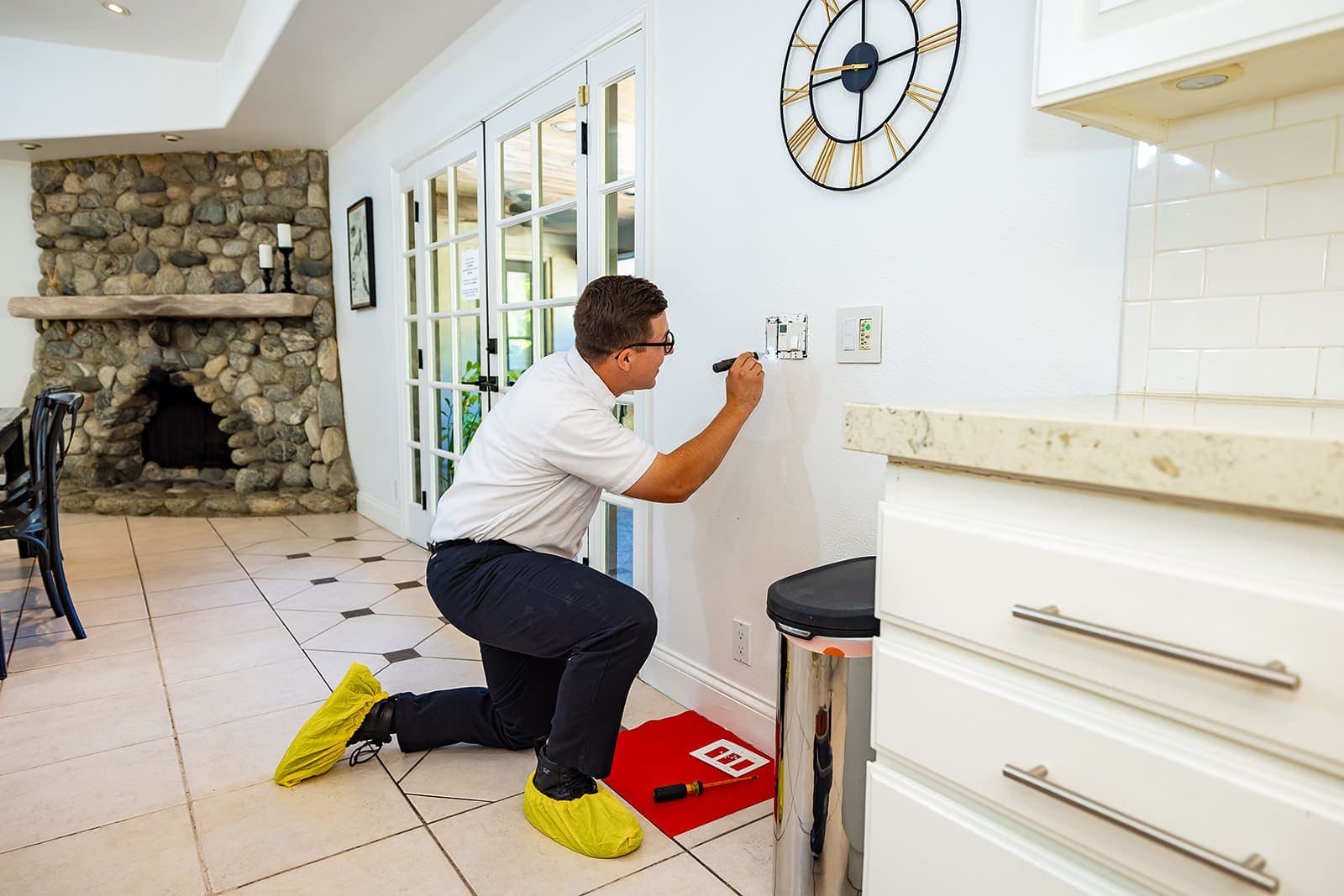
What to Expect
What to Expect During a Flicker Diagnosis
Flicker diagnosis is pattern-reading plus measurement. Here is how the evaluation runs.
- 01
The pattern gets mapped first.
Which rooms, which triggers, which times of day. Your observations get combined with measurements, which is why noting the pattern before the visit genuinely helps.
- 02
Voltage behavior gets measured under real load.
The system is read while the AC actually cycles, because a system that looks healthy at idle can sag hard under inrush.
- 03
Connections get checked at every terminal.
Heat-loosened terminations are a signature desert finding. Tightness is checked at every connection point on the affected circuits, standard on every Home Team Electric evaluation.
- 04
You get the cause and the fix in writing.
Whether it is a connection, a breaker, capacity, or a utility-side referral, you get the finding in plain language and guaranteed pricing before any work begins.
Backed by the Work
Certified Expertise and a Fully Stocked Truck
A service fee covers the visit and a fully stocked truck. Our team includes certified residential specialists, electricians in training, and apprentices, and a certified electrician leads or oversees the work in your home. That standard is built on verified field experience, formal technical education, rigorous testing, and ongoing training (weekly classroom training in our own training room). Pricing is presented in full and approved before any work begins. Same-day service available.
- California C-10 Electrical Contractor License #879507. Verify it at cslb.ca.gov.
- Home Team Electric works exclusively on residential electrical systems in desert conditions. All work is code-compliant and backed by our Lifetime Workmanship Guarantee.
Stop wondering what the flicker means.
Book a service call with an electrician who works desert homes every day.
Google Search
Get more of our updates on Google
If our work has been helpful, add us as a preferred source: Google will show more of our updates in your Top Stories and AI results. It only changes what you see.
Add as Preferred Source