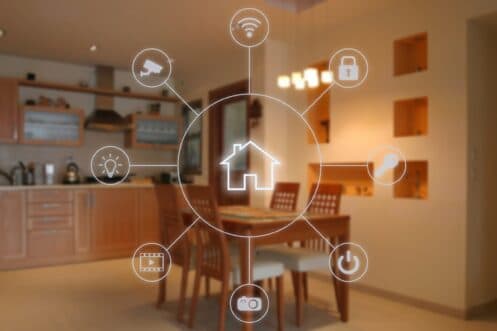
With the rising cost of electricity, many homeowners are looking for ways to reduce their monthly expenses. One of the best investments you can make is in smart home automation. This allows you to monitor, control, and effectively reduce your home’s energy consumption so that you can lower your energy bills.
What Is Smart Home Automation?
The concept of smart home automation involves using sensors, software, and other connected devices to both automate and remotely control the various systems throughout your household. These include everything from your lighting to your HVAC and even your appliances. With smart home automation, many of these devices have integrated learning technology that will automatically adjust to meet your changing habits to further optimize your energy savings.
Understanding the Biggest Energy Users
Before we dive into how you can implement smart home automation to lower your energy bills, we first need to jump into explaining the biggest energy-draining appliances in your household. Your home heating and cooling system is the biggest energy user, accounting for about 50% of your home’s total energy usage.
Your water heater is next on the list, coming in at about 16 to 18% of your annual energy consumption. Lighting sits in the range of about 10 to 15% while your appliances and other electronics tend to make up the rest of your energy usage. It’s vital to understand how these appliances affect your energy bill, so you can use smart home automation to significantly cut down on the energy that they use.
Must-Have Smart Home Devices
There’s an abundance of smart home devices you can purchase for your household to better optimize your energy usage. Below, we’ll discuss some of the most crucial aspects and how you can successfully implement them to reduce your household’s energy waste.
Smart Thermostat
With your HVAC system taking up the majority of your energy usage, it only makes sense to start there with reducing your energy consumption. One of the best ways you can do that is by using a smart thermostat. A smart thermostat has all the benefits of a programmable thermostat, with many other great features like machine learning and geofencing technology.
The US Department of Energy suggests that if you alter your thermostat by 10 degrees for about eight hours during the daytime, you can reduce your annual energy usage by up to 10%. With a smart thermostat, you can optimize by changing the temperature at times when you’re not going to be home.
For example, with geofencing technology, your thermostat can automatically turn down the temperature by 10° during the winter months when your smartphone leaves your property. This will allow you to lower your energy consumption when no one is home and automatically allow your thermostat to turn back up before you arrive home so that you’re nice and comfortable when you walk in the door.
Smart Lighting Systems
Another smart home integration that’s fairly easy to do is smart lighting systems. There’s no doubt that traditionally incandescent bulbs can waste a ton of energy. When you switch to LED bulbs, you can save energy and further optimize those energy savings by integrating smart lighting technology. This technology will let you remotely control all the lighting throughout your home from anywhere your smartphone has connectivity.
You can integrate a set schedule for when your lights automatically turn on or off, such as when you go to bed. You can install dimming features that will reduce the brightness to extend bulb life and lower your energy bills during the evening hours when you don’t need it to be so bright. Furthermore, you can integrate motion sensors that will only light up rooms that you walk into and automatically shut all the lights off when you leave.
Smart Plugs and Outlets
One fact that shocks a lot of homeowners is that everything you have plugged into an outlet still draws phantom power even if you have it off. Over time, this phantom load can increase your energy bills without you even using the device. Smart power strips and plugs give you the ability to actually cut off the power to electronics and appliances so they no longer draw phantom energy.
The majority of smart power strips and plugs allow you to program a set schedule for when your outlet will turn off or on. This automation allows you to reduce your energy consumption at times when you know you don’t need to be using that electronic device or appliance. Even better, the smart power strips and plugs allow you to track your energy usage in real time so you can see how slight adjustments can alter your energy bill.
Smart Appliances
Probably one of the easiest ways to integrate smart technology into your home to reduce your energy bills is by purchasing smart appliances. Pretty much every appliance out there can come with integrated smart technology, including refrigerators, dishwashers, standing freezers, washing machines, dryers, and so much more. This smart technology integration gives you more control over the use of the appliance so that you can lower its energy usage.
For example, smart washers will actually adjust the amount of water you use and the cycle length based on the actual weight of the load that you put in the washer. Smart refrigerators will regulate their cooling based on integrated sensors so they don’t use more energy than necessary to keep your items cool.
How Smart Home Devices Lower Your Energy Bills
There’s no doubt that integrating smart devices into your home can provide you with more convenience. However, they are also great for allowing automation to directly reduce your utility costs. Many of these devices can offer to delay energy-intensive tasks, like running your dishwasher, until off-peak utility hours. This means that you can run your dishwasher for less money than if it were to run during on-peak hours.
All of these smart devices give you the ability to monitor their usage in real-time. It’s much easier to make small adjustments to your normal daily routine when you understand how those adjustments affect your energy bill. For example, you can try turning the temperature down on your thermostat by one or two degrees during the wintertime to see how it affects your comfort and reduces your energy bills. You may just find you don’t notice a difference in your household comfort, but you get to see the real-time energy savings that making that one change can provide you.
Getting Started With Smart Home Automation
There is no lack of smart home devices out there that you can include in your smart home automation system. When you first start looking, it can be overwhelming to determine where to start. We highly suggest starting with the biggest energy consumers, like your HVAC system.
Installing a smart thermostat is very easy to do and gives you the ability to make the biggest impact on reducing your bills. Once you get that installed, consider moving on to smart lighting or even just some smart plugs that can help you better identify your wasteful devices. By adding more and more smart home devices over time, you can work to make your home more energy-efficient.
Reliable Smart Home Service
Home Team Electric offers reliable smart home electrical service for the Coachella Valley, CA area. We can also assist with all your household electrical installation, inspection, and repair needs. Just call our office today to book your next service appointment.
Google Search
Get more of our updates on Google
If our work has been helpful, add us as a preferred source: Google will show more of our updates in your Top Stories and AI results. It only changes what you see.
Add as Preferred SourceWritten By

Frank Luersen
leadership
There's a running tradition inside Home Team Electric called Frank Pranks, and it says everything about the kind of culture Frank built. Ask anyone on the team about it and they'll grin before they finish explaining it. Someone sets it up, he walks right into it, the room erupts, and whether he actually sees it coming is still an ongoing debate. Frank could settle it anytime. He hasn't.
California C-10 Electrical Contractor License #879507. Verify it at cslb.ca.gov.
Published September 9, 2025